| |
| |

|
|
Venue
|
|
| |
|
NLPD, Islamabad
|
| |
|
|
|
| |

|
|
Dates
|
|
| |
|
15 & 16 May, 2024
|
| |
|
|
|
|
|
| |
| |

|
|
Speakers
|
|
| |
|
> 65 Speakers
|
| |
|
|
|
| |

|
|
Sessions
|
|
| |
|
12 Sessions
|
| |
|
|
|
|
|
|
|
|
|
|
Comparative Study of Mevlana Rumi and H̱aḏrat Sultan Bahoo's Works
|
|
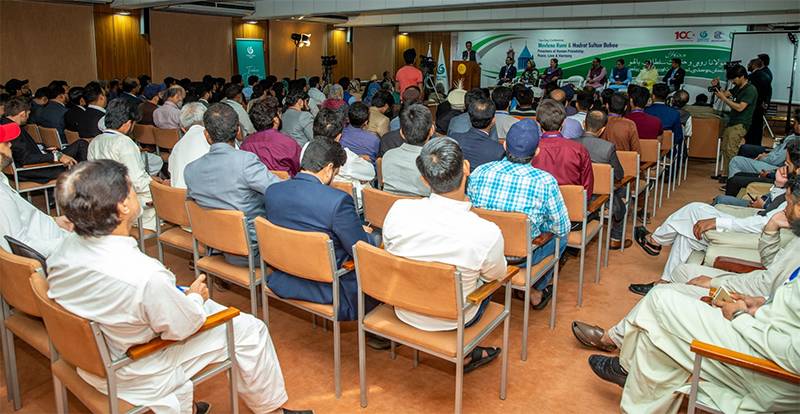
The session was chaired by Dr. Rashid Hameed, Executive Director of the National Language Promotion Department, Islamabad. The session was moderated by Dr. Abdul Basit, Assistant Professor at SMCS, UMT, Lahore.
|
|
|
|
|
|
|
|
The summary of the speakers' remarks is as follows:
|
|
|
|
|
|
|
Modern humans can no longer be considered true individuals. From birth, they are handed over to schools where they are confined and taught limited knowledge. They work for capitalists, for whom they have no ideological connection, toiling for their gain, even at the expense of their children.
|
|
|
Rumi and Sultan Bahoo emphasized the unity of being, a concept in contrast with Descartes' assertion, "Cogito, ergo sum" (I think, therefore I am), which reduces humans to mere rational beings. Their works transcend mere intellect, reaching into realms of intuition and spiritual knowledge.
|
|
|
|
|
|
|
|
|
|
Addressing the theme of organizational ethics, it is evident that Marx predicted humanity's alienation from urban life. The modern era's man, devoid of spirituality, lives an alienated existence. The teachings of Rumi and Sultan Bahoo remind us of the deeper spiritual dimensions of life that go beyond mere rationality and material gains. They urge us to rediscover the inner universe, richer than the outer one, and to live in a way that transcends the disenchanted modern world.
Whether we look at the works of Mevlana Rumi or Sultan Bahoo, in prose or poetry, they convey the same message: the message of Ma‘rifat (Recognition of Allah).
|
| |
|
|
|
|
|
Ma‘rifat teaches an ordinary person to become a complete human and reminds them that God sent them as His representative. It guides them on how to fulfill their duties properly to manifest as a true human.
|
|
|
|
|
|
|
Mevlana Rumi's couplets, found at the beginning of Iqbal's Persian collection, epitomize the essence of humanity. He speaks of overcoming devilish and beastly traits to become a complete human being. Mevlana Rumi's renowned book, the "Masnavi Ma'navi," and his other works like "Fihi Ma Fihi" and "Majalis-e-Sab'a" provide profound insights into human nature and spirituality. He used Quranic verses, hadiths, and anecdotes to guide people toward a true understanding of their faith. Sultan Bahoo also emphasized inner knowledge over external learning. His works, predominantly in Persian prose, focus on spiritual insights and guide seekers towards the truth. His famous couplet below, reflects his approach to Ma‘rifat:
|
| |
|
|
|
|
|
If you seek the truth, come to me, and I will take you from beginning to end in a moment
|
|
|
|
|
|
Comparing the works of these two mystics reveals that despite the differences in their times, Mevlana Rumi and Sultan Bahoo's messages align closely in guiding humanity toward spiritual completeness. They both:
- use poetry and prose to explain complex spiritual concepts and encourage adherence to spiritual and moral values.
- Offer spiritual wisdom and guidance that transcend their eras.
|
|
|
|
|
|
Society is influenced by three main elements: culture, language and literature, and intellect. As Sufi figures, Mevlana Rumi and Sultan Bahoo profoundly influenced the culture of their eras and subsequent generations. Concepts such as tolerance, humanity, love, and mysticism were promoted by these Sufi masters. Mevlana Rumi, through his teachings and practices, left a lasting cultural impact, evident in the whirling dervishes and traditional Sufi attire still seen in Konya today. Similarly, Sultan Bahoo's influence can be observed in the distinctive characteristics of his followers.
|
|
|
Their literary contributions are monumental. Rumi's "Masnavi" is cornerstone of Persian literature, containing parables and stories that impart wisdom. Sultan Bahoo's Punjabi verses preserve unique linguistic expressions, enriching the literary heritage. Furthermore, the intellectual legacy of these Sufi masters is significant. They reconstructed metaphysical concepts, offering deeper insights into spirituality and the human experience. Sultan Bahoo, for instance, emphasized the necessity of a true spiritual guide and the experience of divine presence, reshaping metaphysical understanding.
|
|
|
|
|
|
|
|

|
|
The poetry of Sultan Bahoo and Mevlana Rumi was not merely a means of self-expression but a medium of teaching. They used poetry to convey their inner thoughts to others because of its appealing form, but they did not rely on rhetorical flourishes or embellishments. Their words were powerful and resonated deeply. Sultan Bahoo's works contain profound wisdom, the energy and authenticity in their words made their teachings impactful.
For instance, Sultan Bahoo’s teachings are aimed at both the learned and the common folk. His sayings, like "Knowledge without manners is useless," highlight the importance of ethics. His poetry addresses the human condition and offers practical guidance for living a righteous life.
|
| |
|
|
|
|
|
Moral & Ethical Perspective
|
|
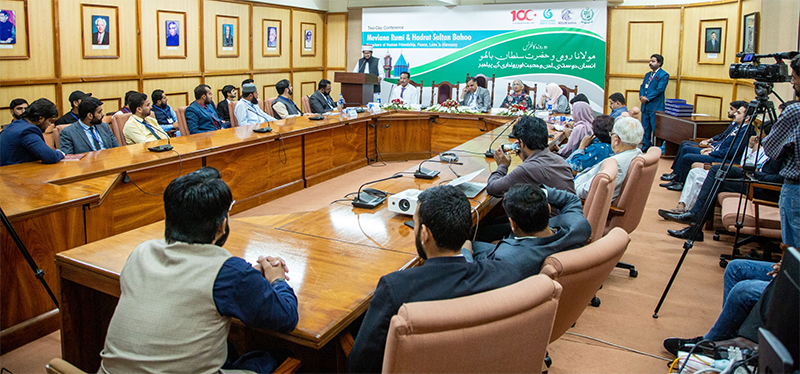
The session was chaired by Prof. Dr. Syed Habib Bokhari, Vice Chancellor of Kohsar University Murree.
The proceedings of the session were moderated by Mr. Babar Jan.
|
|
|
|
|
|
|
|
A brief summary of the remarks shared by the speakers is as follows:
|
|
|
|
|
|
‘Nafs-e-Ammara’ and ‘Youth’
|
|
In the teachings of H̱aḏhrat Sultan Bahoo, self-improvement negates worldly desires and leads a person towards the true path of love for Allah. Every selfish desire that causes distance from God falls under the category of the evil commanding soul (Nafs-e-Ammara). Utilizing the nafs for human welfare transforms it into a good commanding soul. However, the same nafs turns into a curse for humans when it serves illegitimate desires. A person can abandon the evil soul (Nafs-e-Ammara) by adopting the Zikr of Allah under the supervision of a perfect spiritual mentor within the sphere of Shari'ah. Furthermore, Allah loves those who worship and obey Him in their youth. According to Mevlana Rumi:
|
|
The self remains rebellious in following the true path during youth. However, under the guidance of a perfect mentor, a person can follow the path of self-correction and avoid pursuing false worldly desires. The mortal world is for humans and humans are not for it.
|
|
|
|
|
|
|
|
|
|
Imam al-Ghazali says: If a person sees one evil in an individual, he should remember ten of his own evils. The saints of Allah have always acted gently and benevolently, a practice taught by the legacy of the Prophets.
Moreover, Satan did not act humbly in the presence of God and has remained guilty of disbelief. H̱aḏhrat Sultan Bahoo says that the person who kills his evil commanding self with the sword of the Name of Allah is saved.
|
|
|
Man should replace his negative attitudes with positive ones because he has arrived to make this world beautiful, not ugly. It is necessary to love His creation before admiring Him. A good Muslim sacrifices everything for the sake of God. Both Mevlana Rumi and H̱aḏhrat Sultan Bahoo have the ideology of wahdat-ul-maqsood (unity of purpose). They have guided for a particular cause, kept the dark hearts alive, and gave the message of peace and love to the masses.
|
|
|
|
|
|
|
|
|
|
|
After the announcement of prophethood, the Prophet Muhammad (ﷺ) responded to all objections raised against him by the virtue of his character. He called the people towards peace and the religion of Islam. Moreover, knowledge increases information, but a practical model is needed to develop one’s character. In Sufism, there is no place for double standards; it demands purification of both the inner and outer self of an individual. Therefore, the mercy of Allah reveals itself to those who possess purity in self and cleanse themselves from false worldly desires.
|
|
|
|
|
| |
|
A perfect mentor of the soul can lead the seeker to his destination.
|
|
|
|
|
Applying and practicing true knowledge is a hallmark of Sufi saints. Their higher moral values spread the light of civilization among the masses. This encourages the abandonment of evil practices and helps in following the straight path. Thus, a perfect human being is one who progresses in socialization and enlightenment in this world.
There is an utmost emphasis on character building in the teachings of Mevlana Rumi and H̱aḏhrat Sultan Bahoo. In the contemporary world, there is lack of love, humanity, peace, brotherhood, and harmony. Nature has endowed every human with a brain. However, how an individual trains their mind is what truly matters. The purpose of knowledge should be to gain familiarity with oneself. We should strive to understand ourselves rather than focusing on others and aim to make ourselves role models.
|
|
|
|
|
|
|
|
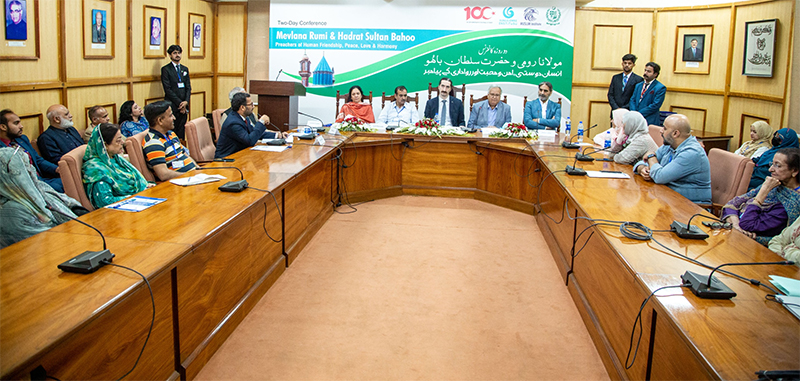
TThe session was chaired by Mr. Eren Miyasoglu, Turkish Lecturer at Yunus Emre Institute, Pakistan.
The proceedings of the session were moderated by Dr. Abdul Basit, Assistant Professor, UMT, Lahore.
|
|
|
|
|
|
|
|
A brief summary of the remarks shared by the speakers is as follows:
|
|
|
|
|
Pakistani society is a mix of different cultures, with people accustomed to speaking various languages. Culture is creative in its structure, and different components of culture influence human behavior. Every culture and language develop and spread through interaction with other cultures. Pakistan was formed on an ideology based on the universal teachings of Islam. The lineage of various Sufis, spread across different regions of Pakistan, enlightened their areas with values of spirituality. They established a system for the spiritual training of people, which imparted a positive impact on both society and culture.
If we study the words of Sufis who flourished in Punjab for many centuries, from Baba Farid Ganj Shukar to Mian Muhammad Bakhsh, we will see that all the colors of civilization and culture are present in their poems. H̱aḏhrat Sultan Bahoo is also a member of this lineage of Sufis, belonging to the Sarwari Qadriya order. He wrote numerous books in both Persian and Punjabi languages. His most famous book, "Abyat-i-Bahoo," written in Punjabi, reflects Punjabi culture. He shared his spiritual experiences through his writings in Punjabi, drawing material for his poetry from his spiritual life and adapting it to his aesthetic vision, which heralded a new direction.
|
|
|
|
|
|
|
|
Sufism involves conquering the world while living in it. According to the Sufis, renunciation of the world means knowing good and evil and relinquishing what is harmful. Sufis welcome all without discrimination of race, color, or sect. The only way to control the self is to connect with spirituality, which involves purifying oneself by denying all sensual desires.
One consistent theme in the words of every saint is human friendship. H̱aḏhrat Sultan Bahoo says;
|
|
|
|
|
|
تسبی پھری تے دل نہیں پھریا کی لیناطں تسبی پھڑ کے ھُو
علم پڑھیا تے ادب نہ سکھیا کی لیناطں علم نوں پڑھ کے ھُو
|
If moving beads of rosary does not move heart, what is the use of it - Hoo,
If acquisition of knowledge does not inculcate respect, what is the use of such knowledge - Hoo,
|
|
|
|
|
|
ما ز قرآن مغز را برداشتیم
|
|
We have understood the essence (the reality) from Holy Quran, and presented it.
|
|
|
|
|
|
In Mevlana Rumi's "Masnavi," we find messages of character building, self-control, and high moral values. By adhering to these principles, we can easily find our way to Sufism. Rumi's poetry draws attention to themes like self-awareness and divine rapture, highlighting how humans often focus on material things while neglecting spiritual knowledge. His teachings offer a pathway to rise from our moral and spiritual decline. Through his poetic expressions, Rumi emphasizes the importance of moving beyond superficial aspects of life to achieve a deeper understanding of oneself and the universe.
|
|
|
|
|
|
ہر کجا ویراں بوَد آنجا اُمیدِ گنج ہست
گنجِ حق را می نجوئی در دلِ ویراں چرا
|
|
When there is loneliness, there is a chance to find gold, then why you don’t find God in the lonely and broken heart
|
|
|
|
|
|
Moreover, Sultan Bahoo's poetry shares similarities with that of Mevlana Rumi. In his poetry, we can observe spiritualism, morality, love, humanity, and harmony, all expressed through the native language as well as in Persian. This is why his poetry brings people closer to Allah. He not only develops external character in his poetry but also nurtures the soul.
|
|
|
|
|
|
|
TThe session was chaired by Prof. Dr. Mukhtar Ahmed, Chairman of the Higher Education Commission, Islamabad.
Dr. Rashid Hameed, Executive Director of the National Language Promotion Department, Islamabad, moderated the proceedings of the session.
|
|
|
|
|
|
|
|
Summary of the remarks shared by the speakers is as follows:
|
|
|
|
|
|
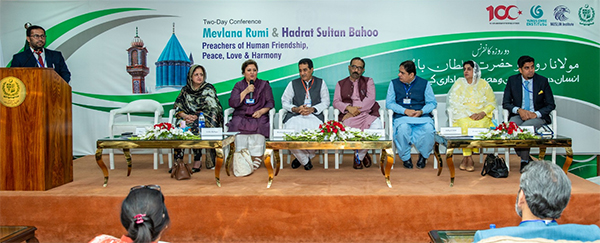
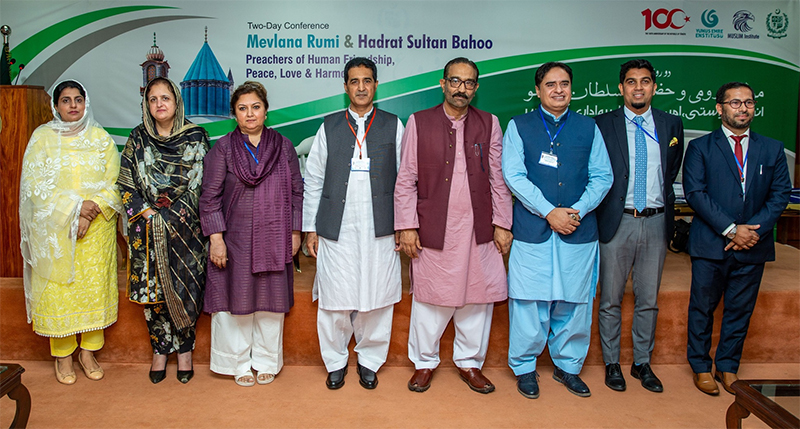
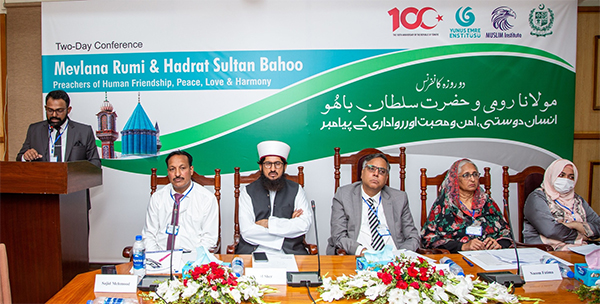
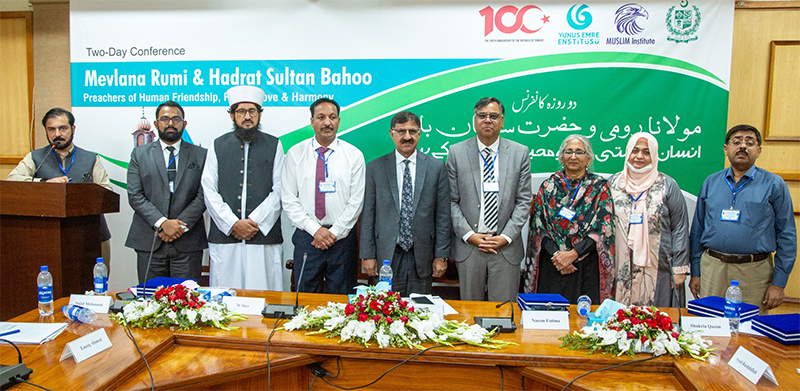
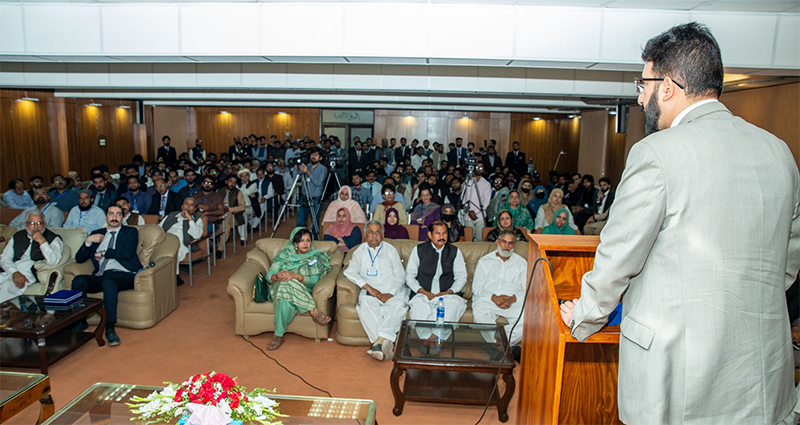
The conference concluded with insightful speeches from learned speakers, who highlighted multifarious social, cultural, and linguistic issues along with their possible solutions in the contemporary world. The central themes of the conference revolved around peace, self-purification, and human dignity as taught by Sultan Bahoo and Mevlana Rumi. Each session of the conference began with soulful recitations of poetic lines from Sultan Bahoo and Mevlana Rumi, with the rhymes of their poetry acting as a spiritual shower, deeply touching the hearts of the participants.
|
|
|
|
|
|
|
In terms of humanistic approach and treatment, Rumi's poem "Guest house" emphasizes treatment according to the practices of the Holy Prophet Hadrat Muhammad (ﷺ). Rumi urges people to overcome the grief of those who are feeble and treat them with respect, following the teachings of the Prophet Hadrat Muhammad (ﷺ). He describes love for humankind as a staircase leading towards God.
|
|
|
|
|
|
|
|
Both Mevlana Rumi and Sultan Bahoo highlighted the path of love through poetic tales and written examples.
For instance, Sultan Bahoo wrote a stanza about a judge who rushes from his prayer hall when he realizes that mere worship of God cannot lead towards Him, but love for humankind and dignity is the secret path that leads straight to God. Sufis like Sultan Bahoo and Rumi are beacons in the path of love and peace, guiding nations towards Allah.
|
|
Participants from every corner of Pakistan contributed to the conference, making it a truly national event. People from Sindh, Balochistan, KPK, Kashmir, Gilgit, and Punjab represented their major regional languages, painting a picture of national unity under the umbrella of literature and linguistics.
Languages were the center of gravity on the second day of the conference on the teachings of Mevlana Rumi and Sultan Bahoo. Emphasis was placed on the study and importance of languages in spreading love and peace among humanity.
|
|
|
|
|
|
|
|
|
The conference highlighted the role of Urdu, Persian, and Arabic languages in literature, also underscoring the challenge of preserving the spirit of literary works in translation.
|
|
|
|
|
|
Furthermore, the conference discussed cultural diversity, emphasizing the importance of learning about different cultures around the world. Both Sultan Bahoo and Mevlana Rumi emphasized the preservation of personal identity while embracing cultural diversity, empowering humans to accept criticism without losing respect for humanity. According to their teachings, peace and harmony can only prevail in a society where people respect and welcome constructive criticism.
|
|
|
|
|
|
|
© 2024. All rights reserved.
|
|
|
|
|
|
|
|