| |
| |

|
|
Venue
|
|
| |
|
NLPD, Islamabad
|
| |
|
|
|
| |

|
|
Dates
|
|
| |
|
15 & 16 May, 2024
|
| |
|
|
|
|
|
| |
| |

|
|
Speakers
|
|
| |
|
> 65 Speakers
|
| |
|
|
|
| |

|
|
Sessions
|
|
| |
|
12 Sessions
|
| |
|
|
|
|
|
|
|
|
|
|
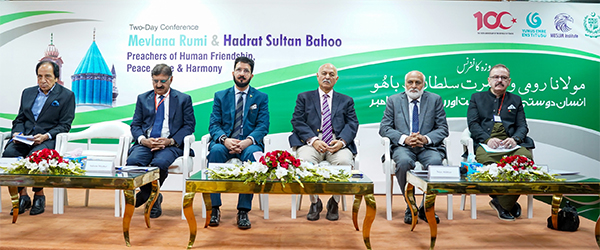
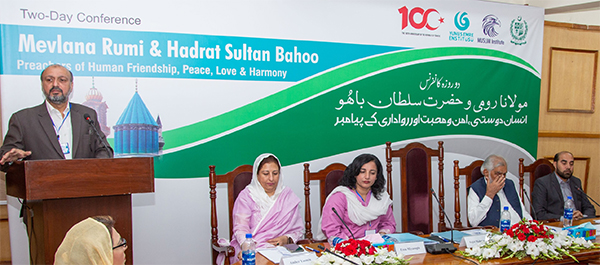
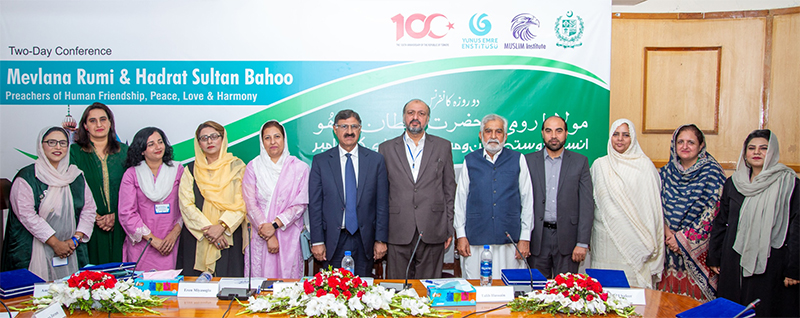
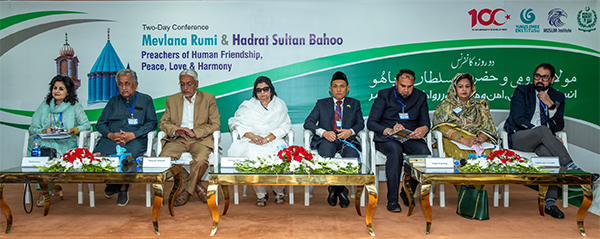
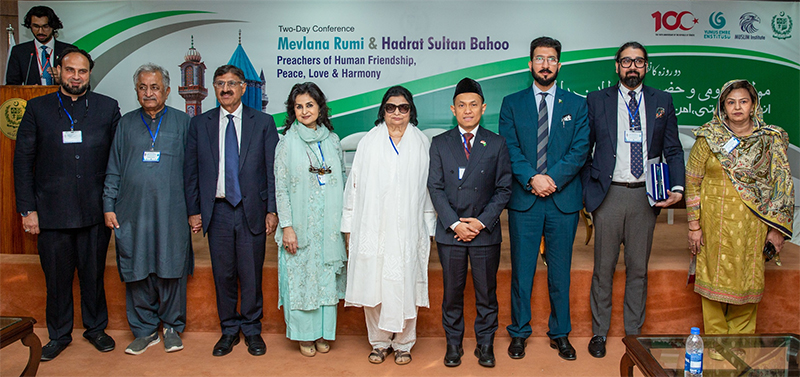
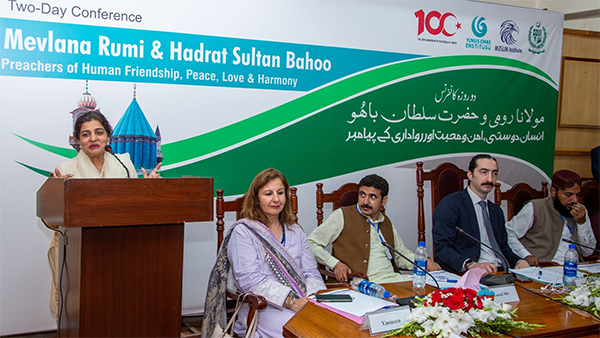
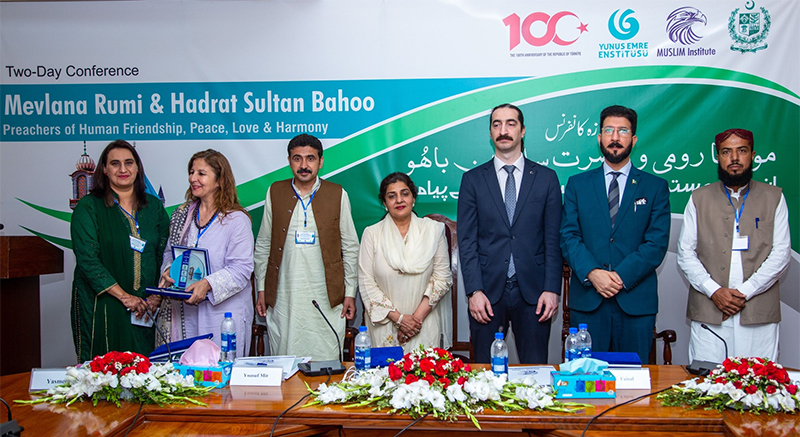
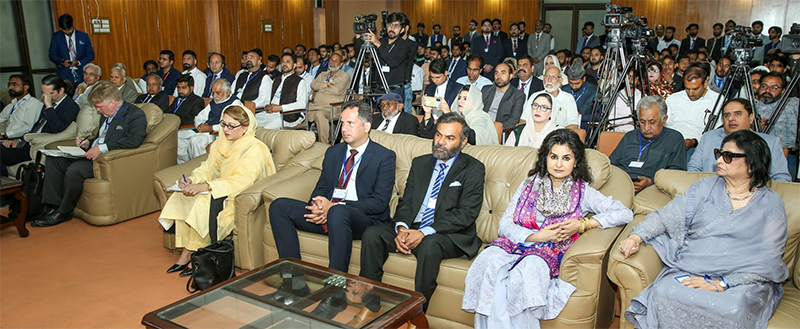
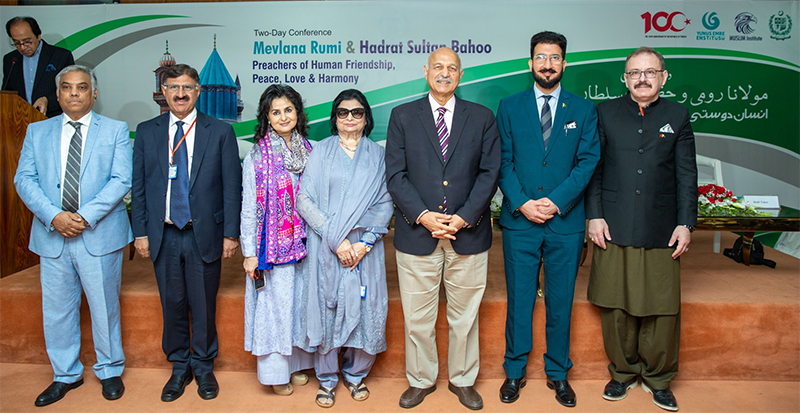
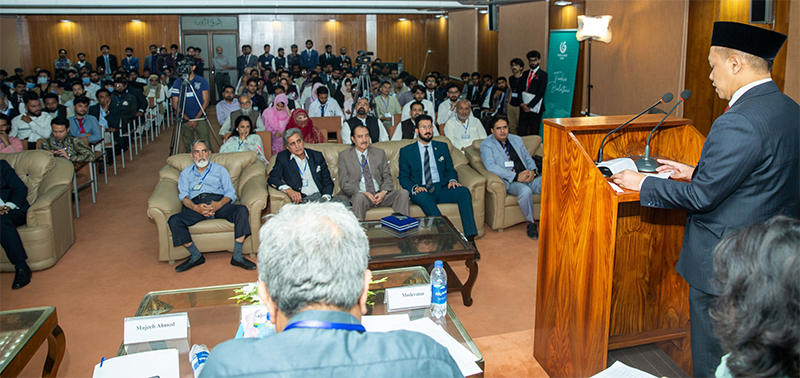
Senator Mushahid Hussain Sayed, a renowned analyst, chaired the inaugural session. Sahibzada Sultan Ahmed Ali, Chairman of the MUSLIM Institute, presented the introductory remarks, while Prof. Dr. Muhammad Saleem Mazhar, Director General of the National Language Promotion Department, Islamabad, offered the welcoming remarks. Mr. Mehboob Zafar, a poet and writer, moderated the proceedings of the inaugural session.
|
|
|
|
|
|
|
|
A summary of the remarks shared by the speakers is following:
|
|
|
|
|
|
|
Mevlana Rumi and H̱aḏhrat Sultan Bahoo state that the greatness of a person cannot be judged based on physical appearance. True greatness is determined by the heart. The artificiality in this world is the enemy of contentment and peace. One must delve into his inner self to understand the level of contentment. According to the Holy Qur’an, if Allah Almighty is pleased with someone, He bestows peace and contentment upon his heart.
|
|
|
Secondly, H̱aḏhrat Sultan Bahoo and Rumi preach nurturing of respect for others. Listen in to differences of opinion, regardless of your identity, religious beliefs, political and social views, or opinions on any matter. What matters are your ethics, manners, dealings, and how you play your part in society. Mevlana Rumi and H̱aḏhrat Sultan Bahoo have a specific religious background, yet they delivered their message at humanity’s level without being impacted by their religious identity.
|
|
|
|
|
|
|
|
|
|
|
There is a saying about the funeral of Rumi: the Seljuk Sultan also participated in the funeral, and a few people complained to the Sultan about Jews reciting the Torah and Christians reciting the Bible while walking with the funeral. When rabbis of the Jews and priests of the Christians were asked for the reason, they explained that if Muslims could see the manifestation of the characteristics of Prophet Muhammad (ﷺ) in Rumi, they could similarly see the manifestation of attributes of Mūsá, Dawood, Sulaiman, and ‘Īsa. The love these Sufis earned is mainly due to their tolerance for differences of opinion. H̱aḏhrat Sultan Bahoo, with all his identities, says that:
|
| |
|
|
|
|
“I am neither Sunni‘ nor Shia‘ my heart is disgusted with both of them – Hoo
As I entered the ocean of Oneness all the journey came to an end – Hoo”
|
|
|
|
|
|
When you are sitting with people, your humanity is more important than your beliefs and attire. Humans should align their ethics, character, and attributes with those of Allah Almighty. Be merciful and forgiving to Allah’s creations, as Allah is Merciful, Beneficent, and Forgiving. Allah forgives those who ask for forgiveness and even those who do not ask.
The objective of arranging this conference is to rediscover the human status that has been lost in the artificiality of this world, through the teachings of Mevlana Rumi and H̱aḏhrat Sultan Bahoo.
|
|
|
One of Rumi's sayings goes, "Listen to this flute, it tells the story of being separated from its center." Here, the flute symbolically represents the human spirit. This world is temporary, and ultimately, we all must return to our center. The moment one is separated from one’s center, he begins to struggle to find it again. The same has been preached by H̱aḏhrat Sultan Bahoo. Both these Sufis have spread their light like the sun and moon to everyone, without any discrimination of color, thoughts, or nationality.
|
|
|
|
|
|
|
|

|
|
|
The teachings of Sufis emphasize the strength of character, through which humans find contentment within themselves, thereby cementing the foundation of peace and harmony in society. This is why Rumi is read in Western society as well as within the Muslim world, and also why the Punjabi poetry of H̱aḏhrat Sultan Bahoo is a fundamental aspect of our culture. Their works are being translated and researched worldwide. These Sufis have conveyed a message of human friendship, recognizing the greatness of humanity. Both individuals dedicated their lives to the messages of human respect, love, peace, and harmony in society. They made human love the basis of their message, without considering discrimination, language, sectarianism, etc. Certainly, this two-day conference will help spread the message of these Sufis to our youth and contribute to making society more peaceful.
|
| |
|
|
|
|
|
|
Thoughts of Mevlana Rumi and H̱aḏrat Sultan Bahoo: Science and Metaphysical Perspective
|
|
The session was chaired by Dr. Aalia Suhail Khan, former Vice Chancellor of Rawalpindi Women University. Ms. Mahnoor Qureshi, a renowned journalist, moderated the proceedings of the session.
|
|
|
|
|
|
|
|
Summary of the remarks shared by the speakers is as follows:
|
|
|
|
|
|
H̱aḏhrat Sultan Bahoo argues that divine presence and power transcend the physical laws of the universe, asserting that true power is beyond space and time.
He provided examples where divine power manifests, highlighting the limits of human comprehension. Both philosophy and mysticism seek to understand infinite reality, sharing a common subject in time and space.
|
|
H̱aḏhrat Sultan Bahoo, in Nūr Al-Hudá, states that the ma‘rifat (recognition) of Allah Almighty is possible in this world and described three ways to achieve it.
- Through dreams
- Through the meditation
- Division of the body and soul
Through the spiritual guide's grace, the seeker’s body and soul split into two parts: one remains in this time and space, while the soul appears in the divine presence in a realm beyond time and space, rejoicing in the vision of Allah.
|
|
|
|
|
|
|
|
|
H̱aḏhrat Sultan Bahoo believed in at least two kinds of time and space. One is the time in which man experiences the Divine presence a purely present moment without past or future. The other is the sequential time in which the human body exists, encompassing the past, present, and future. Sultan Bahoo referred to the purely present time as the time of divine presence. When he said, kun fayakūn (Be, and it is), he referred to this pure time.
|
|
Sultan Bahoo envisioned a realm beyond this physical time and space, which he called ‘Lazamān’ (timeless) and ‘Lāmakān’ (spaceless). He believed that he existed in the divine presence even before appearing in this physical form and was sent to this earth, where he is now trapped in physical form.
|
|
|
|
|
|
|
|
|
|
Rumi considered the past and future as veils between man and Allah, not the present. Rumi said that if you remove the veil of past and future, the ultimate reality will be revealed to you. He described the past and future as two names for one thing.
When we become free from the past and future, in the present moment, time continually reveals itself in new forms.
|
|
|
|
|
|
Every moment His Glory manifests anew.
|
|
- The Holy Qur’an (55:29)
|
|
|
|
|
|
|
Ibn Al-‘Arabī, Mevlana Rumi, Sultan Bahoo, and Allama Iqbal all agreed that human existence encompasses both kinds of time. The human body is trapped in temporal and spatial bounds, but the human essence is directly related to the timeless and spaceless realm. Allama Iqbal wrote that when a Sufi is connected with the eternal essence, the entire reality of this temporal realm is revealed to him. Sultan Bahoo, in his book "Ain ul Faqr," quoted a Hadith:
|
|
|
|
|
|
"I have a time with Allah during which no one is near me, neither any close angel nor any prophet."
|
|
- The Prophet Muẖammad (ﷺ)
|
|
|
|
|
|
H̱aḏhrat Sultan Bahoo taught that true knowledge and understanding of the cosmos require complete surrender. Without complete surrender, one cannot achieve the state of witnessing (Mushāhadah). Sultan Bahoo reminded us that true reality is far subtler than our physical senses can grasp.
|
|
|
|
|
|
| Scientist |
Sufi |
| The scientist relies on empirical evidence and observations through tools like telescopes. |
In contrast, the Sufi looks beyond physical perceptions, seeking knowledge through the heart, illuminated by divine light and intuition. |
| There is a clear difference in focus: |
| The scientist is concerned with causes and effects within the observable world. |
The Sufi seeks to understand the essence behind these causes, the Creator Who sets everything into motion. |
|
|
|
|
|
|
|
Einstein, the renowned scientist, said that the material world is an illusion. Science is now proving what Sufis have always said: that the world is a deception. We are made of atoms, which are mostly empty so, when Sufis say that the world is an illusion, they are speaking a truth that science is now discovering.
|
|
|
|
|
|
|
Literary Works of Mevlana Rumi and H̱aḏrat Sultan Bahoo
|
|
The session was chaired by Dr. Sajid Mahmood Awan, Director of the National Institute of Historical and Cultural Research at Quaid-i-Azam University, Islamabad. Ms. Sadia Niazi moderated the proceedings of the session.
|
|
|
|
|
|
|
|
Summary of the remarks shared by the speakers is as follows:
|
|
|
|
|
The great capital of knowledge and literature, which has been evolving in different parts of the Islamic world, has a deep similarity. For example, Arabia, Baghdad, Basra, Madinah, Mecca, Sindh, and Punjab all share the same fragrance. Mevlana Rumi’s renowned book, Masnavi-i-Ma'navi, stands as a significant contribution to literature. Similarly Sultan Bahoo’s 140 books in Persian language is huge contribution to literature.
Both poets Mevlana Rumi and Sultan Bahoo employed mystical advice and talmihat (terminologies) in their poetry. Sultan Bahoo used the term ma‘rifat in his book 'Aqal-e-Bidar'. Ma‘rifat refers to knowing Allah through the medium (Wasila) of the Exalted Prophet (ﷺ). A person who attains ma‘rifat loses his material desires.
|
|
|
|
|
|
|
The concept of ‘ishq (passionate love) is the centrepiece in the literary works of both Mevlana Rumi and H̱aḏhrat Sultan Bahoo. When speaking of ‘ishq:
|
|
"O ‘ishq, tell me, who are you?"
|
|
|
|
"Where do you come from and where do you live?"
|
|
"I live in heartburn and longing."
|
|
|
|
|
|
|
|
|
|
Sultan Bahoo writes in his teachings that the name of killing the self is ‘ishq’ as ‘ishq’ is the thing whose wound causes the heart to suffer from pain all the time, according to him, until the head is cut off by the sword of ‘ishq’, the beloved will not be found.
Sultan Bahoo says;
|
|
|
|
|
|
عشق دانی چیست؟ کشتن نفس خویش
روز و شب سوزش بود دل راز ریش
|
|
|
|
|
Mevlana Rumi writes that not everyone can go in the battle of love, many people burn in the furnace of love and some run away because the path of love is very difficult and requires patience. If so, he burns everything to ashes except the beloved.
Rumi says;
|
|
|
|
|
|
عشق آن شعلهست کو چون بر فروخت
هرچه جز معشوق باقی جمله سوخت
|
|
|
|
|

|
|
|
Love is the medicine of one's sorrow. In love, a person's life changes completely. Love is such power that when it prevails, all arguments and debates become invalid, love makes one lose the language, and then one does not have the courage to engage in any debate, Sultan Bahoo described it like this in his Punjabi poetry. Mevlana Rumi says that love creates a revolution in human life and makes the difficulties, sorrows and bitterness of life easier and sweeter.
|
|
|
Sufis bear the virtue of forgiveness and forgiveness is the greatest virtue. And the first thing a person has to do is to kill the nafs ammārah (evil self), to reach the destination of the nafs lawwāmah (accusing self) and to find the place of the nafs mut̲ma’innah (Satisfied self). And when a person performs a spiritual act, he is encompassed by a spiritual state, but if he wants to sustain this permanently, then it is necessary for him to be in the company of a perfect mentor. All Sufis say that without a mentor you cannot attain the position of mysticism.
|
|
|
|
|
|
|
|
|
In the works of H̱aḏhrat Sultan Bahoo, similes of flowers, colors, and soil are prevalent, and he speaks to the common person as if he is conversing directly with us. Sultan Bahoo's discussions are deeply connected with nature.
|
|
|
|
|
|
|
Works of Mevlana Rumi & H̱aḏrat Sultan Bahoo in Global Perspective
|
|
The session was chaired by Dr. Qaisra Alvi, President of the Pakistan Federation of University Women, Islamabad. Dr. Saira Alvi, CEO
Precision Diagnostic Laboratory USA, moderated the proceedings of the session.
|
|
|
|
|
|
|
|
Summary of the remarks shared by the speakers is as follows:
|
|
|
|
|
|
|
Mevlana Rumi can indeed be regarded as a cultural icon representing spiritual enlightenment. In South Asia, his poetry is revered by nearly all Sufis, and his works are widely embraced. Allama Iqbal, a prominent figure in South Asian intellectual history, considered himself a disciple of Rumi. Rumi's poetry is not only studied in the East but also holds significant importance in the West, evidenced by availability of translations in all leading languages. His most profound contributions lie in Islamic mysticism and spirituality.
|
|
First verse of Sultan Bahoo’s Punjabi poetic collection starts with:
and the Holy Qur’an starts with:
It shows that this is a universal message.
|
|
|
|
|
|
|
|
|
یاریگانہ ملسی تینوں جے سردی بازی لائیں ھُو
|
|
|
|
|
|
|
You will ultimately find your Beloved. It does not matter which sect, religion, or belief you belong to, as long as you have true intentions to reach Allah.
Non-Sufis tend to interpret words solely based on their literal meanings. However, a Sufi approaches words differently, infusing them with a deeper presence and imbuing them with spiritual significance. Through this process, humans can reach the actual essence of words, transcending surface-level meaning.
|
|
|
“A perfect master can create music for the deaf and color for the blind." This statement encapsulates the essence of a Sufi. Various philosophies, and ideologies have emerged through spiritual forces to facilitate the vertical growth of an individual's intellectual evolution. This has led to the promotion of numerous societies and individuals. Furthermore, an individual cannot attain spiritual happiness without acknowledging spiritual existence and its divine patronage.
|
|
|
|
|
|
|
|
اک نگاہ جے عاشق ویکھے لکھ ہزاراں تارے ھُو
لکھ نگاہ جے عالم ویکھے کسے نہ کدھی چاہڑے ھُو
|
|
|
|
|
|
The teachings of these two Sufis have significantly contributed to peace, tolerance, and excellence in society. We acquire these attributes through respect. Rumi eloquently expresses this sentiment, saying, "Let us implore Allah to help us respect those who have self-control; for the undisciplined do not attain it."
|
|
|
|
|
|
|
Social Perspective: Teachings of Mevlana Rumi and H̱aḏrat Sultan Bahoo
|
|
The session was chaired by Mr. Eren Miyasoglu, Turkish Lecturer at the Yunus Emre Institute, Pakistan. Ms. Sadia Niazi moderated the proceedings of the session.
|
|
|
|
|
|
|
|
Summary of the remarks shared by the speakers is as follows:
|
|
|
|
|
|
Social values encompass beliefs, duties, rights, ethics, and a sense of responsibility, along with upbringing, and they are applicable to individuals within society. When individuals deviate from these social values, they distance themselves not only from ethics, duties, rights, and a sense of responsibility but also from their culture and upbringing. To uphold social values in society, nature has established a system. Allah sent prophets and endowed them with miracles so that people could believe in them during challenging times and incorporate their messages into own lives, thus making them part of social values. After the era of prophets concluded, emphasis was placed on following the teachings and traditions of righteous Sufis.
|
|
|
|
|
|
|
The Sufis played a significant role in refining human relationships and manners. The messages delivered by prophets, Sufis, or saints always lead people towards the path indicated by Allah Almighty.
|
|
|
|
|
|
|
|
The esteemed Sufis maintained the purity of their souls to connect with the exalted Prophet Muhammad (ﷺ), keeping themselves free from bodily and worldly impurities. This enabled them to experience divine revelations and mystical states. Keeping the soul illuminated is an integral part of social values, ensuring it remains capable of adhering to ethics and social principles. To attain this state, Sufis engaged in rigorous practices, worship, self-struggle, self-purification, and abstained from worldly distractions.
|
|
|
Among these esteemed Sufis, whether it was Mevlana Rumi or H̱aḏhrat Sultan Bahoo, they reached a status where they could significantly influence and improve the social values of people. They took on the responsibility of educating and nurturing individuals. These noble saints initially impacted their own communities, establishing relationships with local people and communicating in their language. Eventually, their teachings transcended local boundaries and attained universal appeal.
|
|
|
|
|
|
|
|

|
|
Rumi's universal message serves as a beacon of wisdom filled with love, tolerance, and a deep belief in human connections. He advocates for unconditional love, tolerance, patience, and benevolence. His seven advices epitomize the highest sentiments of humanity, transcending religious boundaries and encompassing the common values of all religions. He said:
|
In generosity and helping others,
be like a river.
|
|
|
|
In compassion and grace,
be like the sun.
|
|
|
|
In concealing others' faults,
be like the night.
|
|
|
|
In anger and fury,
be like the dead.
|
|
|
|
In modesty and humility,
be like the soil.
|
|
|
|
In tolerance,
be like the ocean.
|
|
|
|
Either appear as you are
or be as you appear.
|
|
|
|
|
|
|
|
|
|
H̱aḏhrat Sultan Bahoo says, "Clean your heart because Allah lives there." If religion is the foundation, then tas̲awwuf is the ornament.
|
|
These conferences provide great opportunities to learn, recognize, and connect with such great personalities.
|
|
|
|
|
|
The teachings of Mevlana Rumi and Sultan Bahoo offer encouragement and guidance to people from all walks of life, presenting a profound and comprehensive perspective on spirituality. Both Sufis practiced and promoted religious tolerance and harmony through their teachings and literature. They shaped Sufi thought and literature with their ideas and poetry, promoting religious tolerance and harmony, the effects of which are still present today.
|
|
|
|
|
|
|
At the end of the first day of academic sessions, a poetry session was held in which numerous renowned poets presented their poetry.
|
|
|
|
|
|
|
|
© 2024. All rights reserved.
|
|
|
|
|
|
|
|