View online - Download PDF
facebook
twitter
linkedin
youtube
 
picture

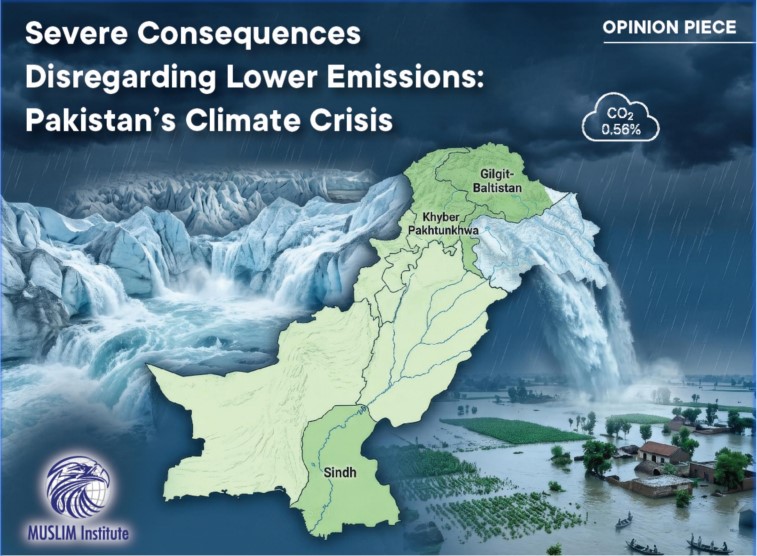
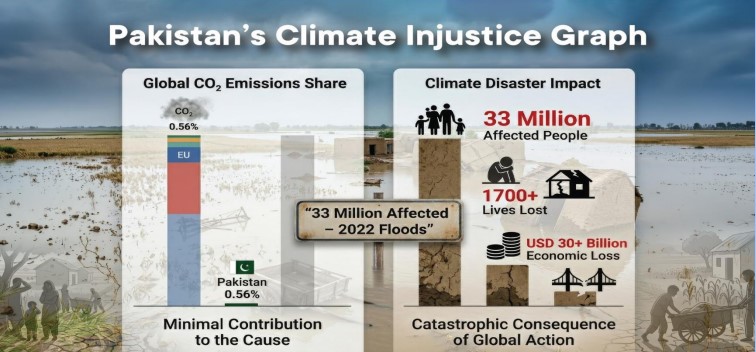
All states on the planet have geographical borders however the climate is commonly shared. An environmental crisis in one country can have far-reaching consequences for the rest of the world. Pakistan is a prime example of such regions. For the past three decades, the said land has been confronted with a severe crisis caused by Climate Change, to ones’ surprise the unfortunate reality is that Anthropogenic Warming by Pakistan is mere less than 1% in the case of the carbon budget, which contributes 66% to global warming.

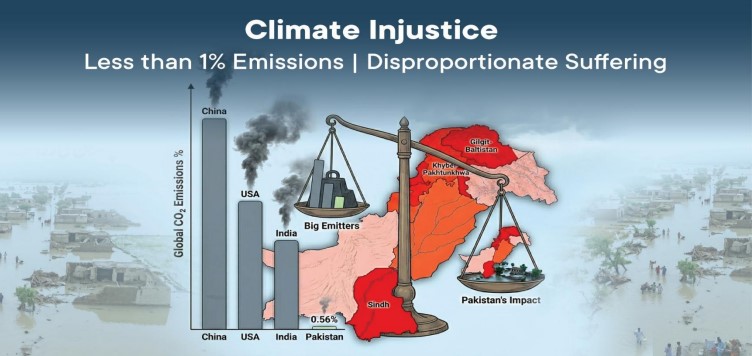
As per the latest statistics available on Worldometer till 2024 the world’s share of CO2 emissions by China, United States, India, Russia and Japan are 33%, 11%, 7%, 5% and 3% respectively. The primary drivers behind these emissions are heavy industrial production, fossil fuel-based power generation and transportation.

As aforementioned, the contribution to these emissions by Pakistan is less than 1% . World Food Program ranks Pakistan among other ten countries facing an acute Climate Crisis. The United Nations Office for the Coordination of Humanitarian Affairs (OCHA) has acknowledged the recent 2022 flood disaster in Pakistan resulting in devastating impacts that affected approximately 6.9 million people. During the UN Climate Change Conference (COP27), the World Food Program (WFP) encouraged the international community to invest in climate adaptation, emphasizing its need for vulnerable countries specially Pakistan.
picture
Pakistan is a victim of extreme climate injustice despite the fact that it is emitting less than 1% carbon emissions of the world. Acknowledging the Climate Injustice faced by Pakistan, António Guterres (UN Secretary-General) stated in press release:

“The people of Pakistan are the victims of a grim calculus of climate injustice. Pakistan is responsible for less than 1 per cent of global greenhouse gas emissions, yet it is paying a supersized price for man-made climate change. One month ago, I travelled there and saw a level of climate carnage beyond imagination: flood waters covering a landmass three times the total area of my own country, Portugal.”

At the COP28 summit in December 2023, King Charles explicitly referenced the deadly flooding in Pakistan and Bangladesh among the most alarming examples of climate-fueled extreme weather, warning that the world was heading into "dangerous uncharted territory" and that humanity was conducting "a vast, frightening experiment of changing every ecological condition all at once."

The said developing state also faces persistent challenges in ensuring pro-active actions to reduce the human loss, infrastructure damage, and financial loss. It is worth considering for the international community to acknowledge the struggle of Pakistan against climate disasters.

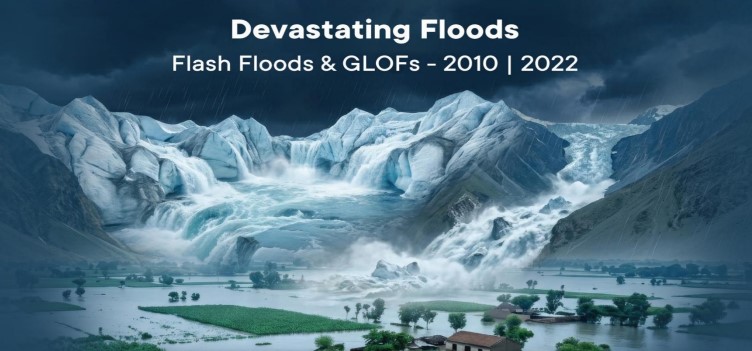
Being located in South Asia, Pakistan is globally recognized as one of the countries with the largest glacial reserves outside the Polar region (The arctic and Antarctic). Flash floods and Glacier Lake Outburst Floods (GLOF) are the most severe repercussions of climate crisis witnessed by the state. Both types of floods are highly triggered by the Global Warming. Humid air of the Arabian Sea adds fuel to fire in the monsoon season. The moisture content increases 7% for every degree Celsius rise in the GMT (Global Mean Temperature).

Consequently, warmer the air, greater its capacity to hold water in vapors which becomes primary source of chaotic change in Monsoon.

picture
 
Similarly for the Glacier Lakes, the rise in atmospheric temperature initiates melting of Glacier and creates outburst floods. Back in July and August 2010, Pakistan Land witnessed huge catastrophic floods which affected approximately 20 million people including more than seventeen hundred people facing death. That flood caused massive destruction of homes, crops, hospitals and other important infrastructure. As reported by NASA Science, around 1.7 million houses were damaged in 2010 flood. The international organizations classified Pakistan as highly affected by climate change.

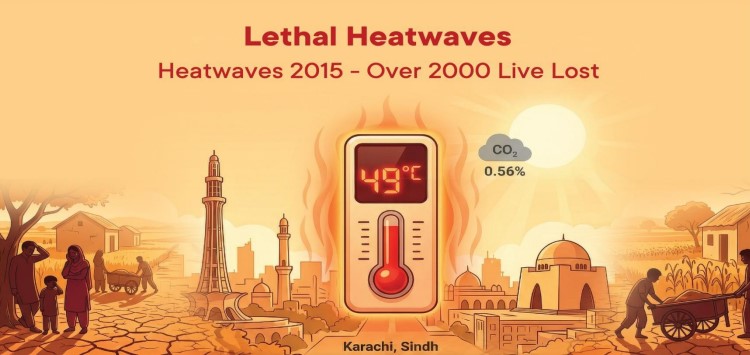
In 2015, heatwave in Pakistan caused the temperatures to risen up to 49 degrees Celsius specially in Sindh and the metropolitan City of Karachi where more than 2000 people fall victim to death. Hospitals got overwhelmed with
 
picture
 
heatstroke patients. The coastal areas usually have high humidity causing water vapors trapped in air with high intensity. High humidity reduces the body’s ability to cool itself through sweating. Rise in temperature along with body’s inability to cool itself causes extreme suffocation.

As reported by NASA, the Global Land-Ocean Temperature Index shows that in last 30 to 40 years temperature rise trend is parabolical or exponential. It is worth noting that the climate crisis in Pakistan is parallel to that parabolic growth dates of Global Land-Ocean Mean Temperature. The exact matching of time is not accidental while clear indications are there that melting of over 1300 glaciers was due to Global Warming.

Another key aspect that depicts Pakistan’s vulnerability is its high reliance on agriculture. It is well established that agrarian systems are inherently sensitive to weather changes; even marginal climate change causes a huge loss to an agriculture-based country. In fact, the 2010 floods destroyed approximately 3.2 million hectares of crops across Pakistan. The community planning in Pakistan is not according to the globally accepted standards of Climate-Resilient infrastructure which remains at risk to the extreme weather conditions. Whenever flood recedes from the lands, it leaves excessive trauma of climate disaster to the people. To such vulnerable communities, these kinds of experiences impact psychologically since the communities do not have alternative sources for reconstructing their houses and feeding their children.

Another traumatic experience of climate disaster has been witnessed between June and October 2022 when unprecedented monsoon rainfall combined with accelerated glacial melt to triggered catastrophic flooding. Almost one-third region of Pakistan was under the water affecting 33 million People. Over 1700 people died in this massive flood, creating a deep mental, financial and social stress to the families of deceased. Pakistan is a developing
 
picture
 
country struggling with many issues at the same time. This trauma is further enhanced and elongated for the countries, consistently struggling with economic crisis. The economic state of the country not only limits the recovery of affected families but also limits disaster management resources provided by the government

It is a universal principal that when an asset is shared among states, the relevant management and protection of the said asset is also a shared responsibility. Climate, as a global common good, must be safeguarded for the survival of life, with greater responsibility resting on states that are major contributors to carbon emissions. It is highly inequitable that the utilization of the carbon budget is majorly by the developed countries but when the time of disasters arrives, the responsibility of managing these disasters remains to a single vulnerable state.

At national scale, the country has undertaken several significant measures, the National Disaster Management Authority (NDMA) had been established in 2007 under the National Disaster Management Ordinance. Several very important responsibilities have been carried out by the NDMA which include preparing national policies and plans for disaster risks, collaborating with international organizations in Human Crisis, awareness in communities about climate disasters etc. The practicality of these policies is still a big question since the outcome has not been as impactful as anticipated. The most recent example of this is the flood of June, 2025 which affected 6.9 million People.

Climate Justice places double responsibility on the high carbon emitting states, a global focus should be on tree plantation in order to form a Carbon Neutral Environment. Transition toward renewable energy sources, instead of continued reliance on fossil fuels, is another practical and effective solution on which considerable progress has already been made.

As discussed earlier the developing countries have weak infrastructure in context of resilience against Climate Crisis, so developed nations should contribute their share in climate mitigation through Climate Financing. There is another pragmatic and effective solution which is the transfer of technology related to modern irrigation methods, heat and flood-resistant construction design, improvements of early warning systems and renewable energy methods to the Pakistan for managing more efficiently through these crises.

In this context, international conferences on awareness of shared responsibility of climate crisis should be conducted by United Nations to educate the international community with emphasis on actionable measures to support Pakistan. The Government of Pakistan should highlight at every platform the fact of vulnerability to climate crisis. Ministry of Climate Change and Environmental Coordination should be consistently engaged with UNFCCC for sharing the current situation of Pakistan’s Climate to secure justice in case of any disaster.

There are several other important international organizations, such as the IPCC (Intergovernmental Panel on Climate Change), UNEP (United Nations Environment Programme), and the World Meteorological Organization (WMO), sustained and consistent engagement with these bodies can help Pakistan better understand its climate vulnerabilities and strengthen its capacity for informed policymaking and effective climate action. International media has the capacity to effectively highlight climate injustice, therefore digital media discussions, seminars, and debates should be organized on awareness of Pakistan’s right to climate justice.

Pakistan, as a responsible member of the international community, must demonstrate its commitment by accelerating the transition to renewable energy, expanding solar and wind capacity, and gradually moving away from its reliance on fossil fuels. Alongside this, the conservation and restoration of forests, wetlands, and natural ecosystems must be treated not as an environmental luxury but as a national priority, given their essential role in absorbing carbon emissions.

At the regional level, it is in the collective interest of South and Central Asian nations to build cooperative frameworks for clean energy sharing, sustainable water management, and coordinated disaster preparedness, recognising that environmental challenges of this magnitude can only be addressed through mutual respect and shared responsibility. The international community has, on multiple occasions, reaffirmed its commitment to collective climate action.

The Paris Agreement represents a landmark consensus to limit global temperature rise to 1.5°C, the Kyoto Protocol of December 11, 1997, established the important principle that historically greater emitters carry a proportionally greater burden of responsibility.

The Nationally Determined Contributions framework under the UNFCCC provides every nation a structured and transparent path toward meaningful climate targets. However, agreements on paper must be matched by action on the ground. Pakistan, which contributes less than one percent of global emissions yet bears a disproportionate cost through devastating floods, glacial retreat, and extreme heat, deserves better than unfulfilled pledges. The moment calls not for further deliberation, but for principled, decisive, and equitable action by all parties
 
 
Author: Engineer Malik Rafaqat Hussain
Research Associate, MUSLIM Institute.
© 2026. All rights reserved.
Unsubscribe - Webversion - Download PDF - Send to a friend