View online - Download PDF
facebook
twitter
linkedin
youtube
 
pict
   
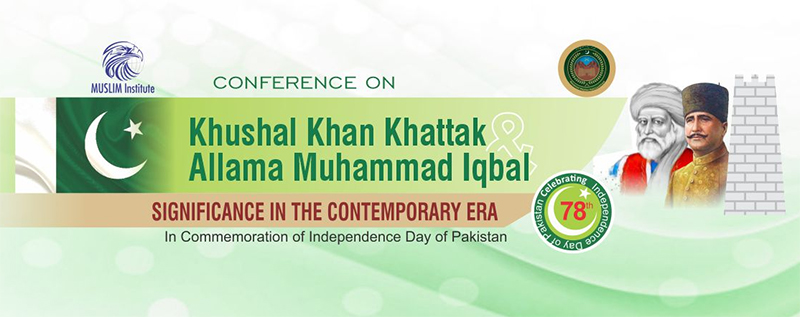
One Day Conference
Khushal Khan Khattak and Allama Muhammad Iqbal:
Significance in the Contemporary Era
Tuesday, August 13, 2024
Organised By MUSLIM Institute
First Session
 
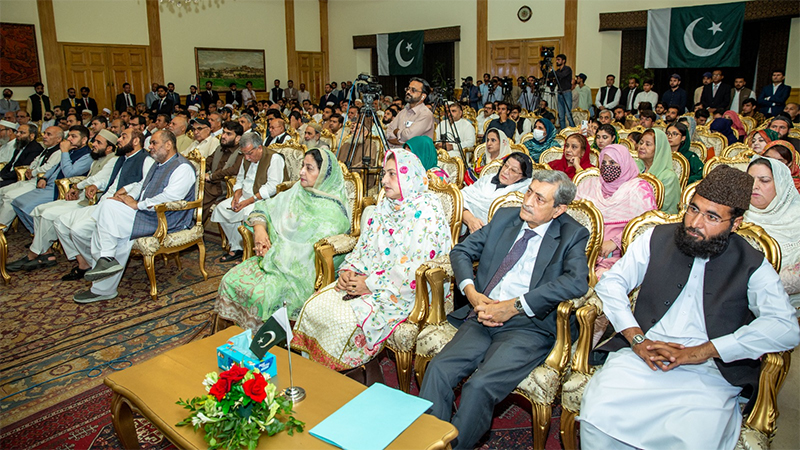
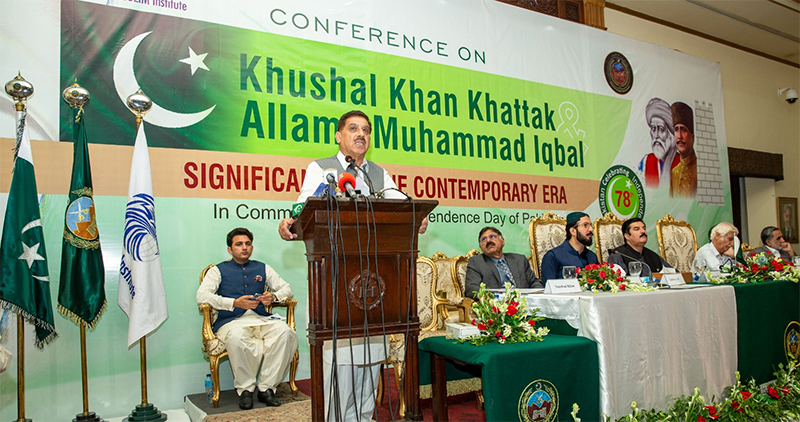
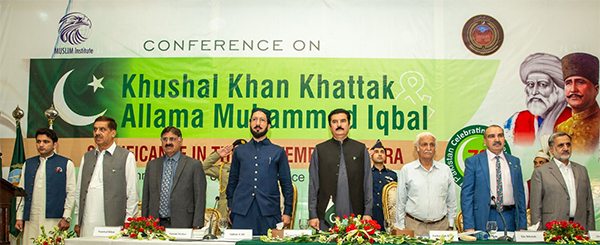
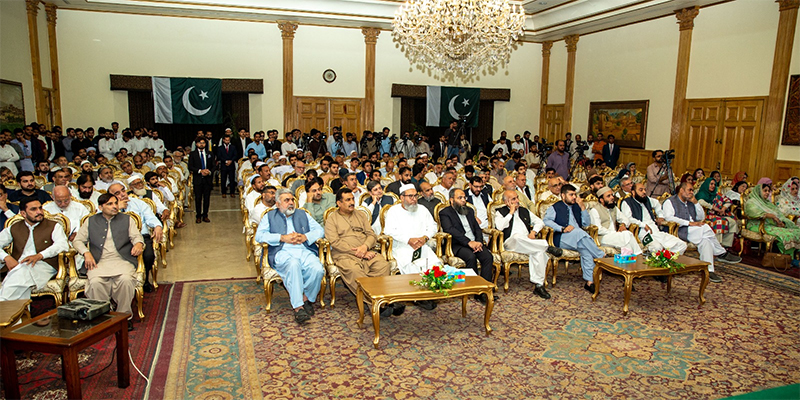
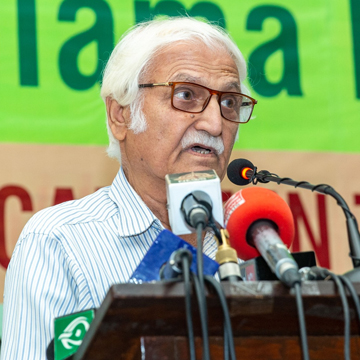
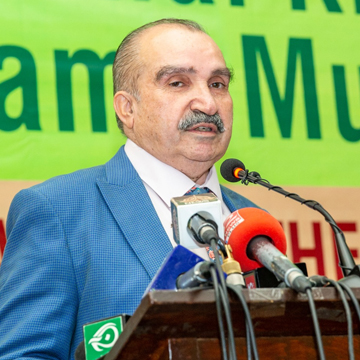
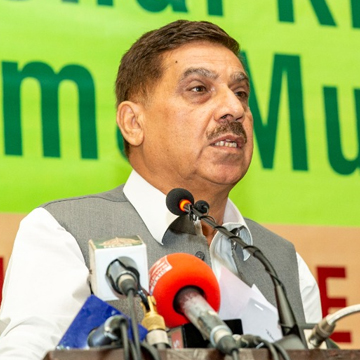
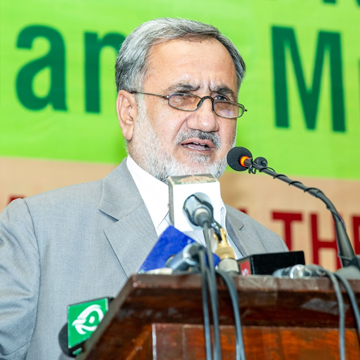
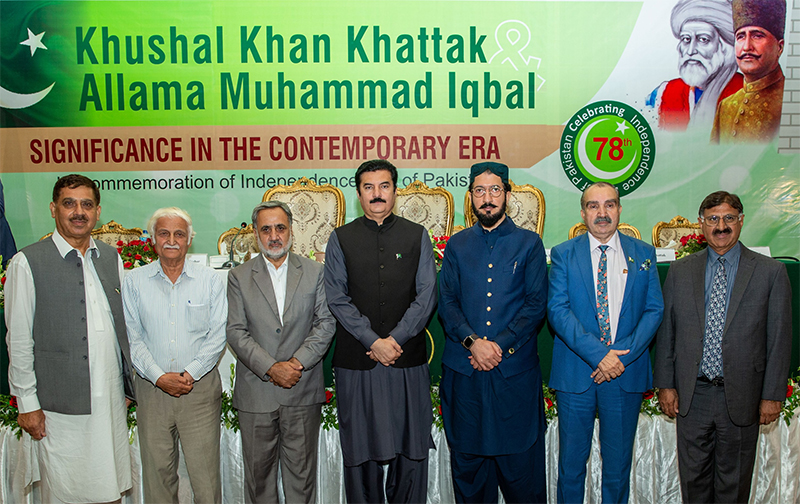
MUSLIM Institute, in collaboration with the Governor House Khyber Pakhtunkhwa, held a conference at the Governor House, Peshawar on Tuesday, August 13, 2024. The event featured an inaugural session and an academic session. His Excellency Faisal Karim Kundi, Governor of Khyber Pakhtunkhwa, delivered the welcome address, followed by opening remarks by Sahibzada Sultan Ahmed Ali, Chairman MUSLIM Institute. The conference attracted a diverse audience, including university vice-chancellors and faculty, members of parliament, literary and intellectual figures, media representatives, policymakers, and individuals from various segments of society. The first session was moderated by Mr. Usama Bin Ashraf.
pict
   
 
Remarks by the Speakers
The following is a summary of the speakers' remarks
 
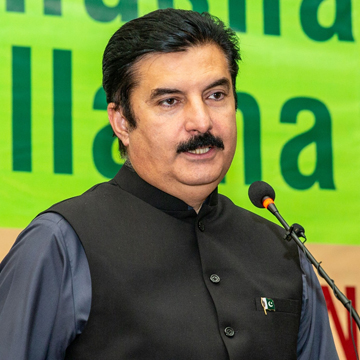
picture H.E. Faisal Karim Kundi
Governor Khyber Pakhtunkhwa
 
On the occasion of Pakistan's Independence Day and in the backdrop of current circumstances, this conference draws upon the profound thoughts and ideas of two of Pakistan's most revered figures: the Poet of the East, Dr. Allama Iqbal, and the esteemed Pashto poet and intellectual, Khushal Khan Khattak. The philosophies of both poets serve as guiding beacons in all aspects of life. Allama Iqbal's admiration for the eagle was rooted in the bird's qualities of self-control and honour, while Khushal Khan Khattak's philosophy emphasised living a life of independence. Through his poetry, Allama Iqbal sparked an intellectual revolution among Muslims, instilling in them a deep yearning for freedom from British Colonial rule. Similarly, Khushal Khan Khattak's poetry inspired a sense of dignity and valour in his people. The poetry and philosophy of Khushal Khan Khattak and Dr. Allama Muhammad Iqbal continue to resonate across generations and regions, offering timeless wisdom. Allama Iqbal keenly understood that materialism and greed are the primary causes of humanity's deviation from the righteous path.
 
 
picture
 
The younger generation should strive to embody the qualities of the eagle as envisioned by Allama Iqbal and Khushal Khan Khattak, working to eliminate all evils and make the world a better place.


pict
   
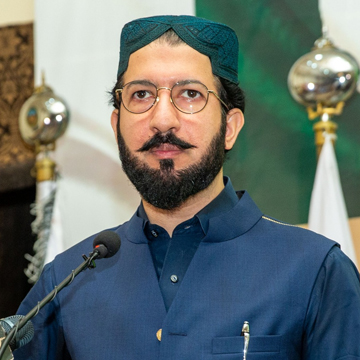
picture Sahibzada Sultan Ahmed Ali
Chairman, MUSLIM Institute
Allama Iqbal's reflections on tribes, their traditions, and their promising future highlight his deep affection for the Pashtun tribes. He believed that the fundamental quality for any nation is the inherent nature of tribal people, a quality he especially wished to see embodied among Muslims. Attributes such as honor, courage, and self-reliance were essential in Iqbal's eyes. Iqbal was one of the first to identify metaphors of freedom in the Holy Qur'an and present them to awaken the spirit of liberty and independence in the nation. Similarly, Iqbal drew inspiration from the Holy Prophet Muhammad (SAW), particularly the ideals of freedom, the freedom to love, revelation, and the belief in the Oneness of God. Iqbal also found these ideals mirrored in the Companions of the Prophet and further discovered the same spirit of freedom in figures like Hazrat Hussain (AS), Saladin Ayyubi, and Sultan Tipu. In his quest, Iqbal encountered Khushal Khan Khattak, with whom he identified through shared values of freedom, honor, honesty, nobility, national unity, and passion.

Peshawar is a center of Central Asia and South Asia, with its own ancient cultural values. Khushal Khan Khattak is a representative of that civilization. Iqbal also considered Ahmad Shah Abdali part of the same legacy that followed Khushal Khan. Despite this, across the border in India, movies are directed to diminish the cultural attributes and identity of the Afghan people. According to Shashi Tharoor in his book 'An Era of Darkness: The British Empire in India', India contributed 29% to the global GDP.
 
picture
 
India contributed 29% to the global GDP under the rule of Turks and Afghans. Our ancestors made India a major economic power. We should not remain silent on the invasion of our culture. We should answer it ideologically, educationally, intellectually and give them our stance on this invasion.


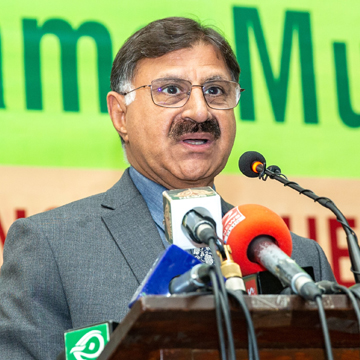
picture Prof. Dr. Saleem Mazhar
Director General National Language Promotion Department, Islamabad
 
Iqbal drew inspiration from Khushal Khan’s translated works. This highlights Khushal Khan’s intellectual excellence, as even a scholar of Allama Iqbal’s stature found value in his writings. Khushal Khan was not only a freedom fighter but also a staunch defender of his civilization’s moral codes. He remained unwavering and uncompromising in his values despite the challenges he faced. The shared ideals of freedom and resistance to slavery found in Allama Iqbal’s poetry further link these two great personalities in a common cause. Another similarity between Khushal Khan Khattak and Allama Iqbal is their emphasis on the importance of seeking out and learning from individuals who possess exceptional humanistic and spiritual qualities. Even today, humanity is in need of guidance from such spiritual and intellectual figures. Both Allama Iqbal and Khushal Khan Khattak remain underexplored sources of wisdom, with their literary works containing priceless insights. Iqbal once lamented that while people claimed to be his friends, they failed to understand to whom he was addressing his poetic messages. Similarly, Khushal Khan’s literary contributions are not widely accessible to the general public.
 
 
picture
 
There is a pressing need to properly compile Khushal Khan's works and translate them into various languages. Universities and linguistic departments should take up this task, which would undoubtedly be a benevolent contribution to humanity.


picture
picture Senator Farhatullah Babar
Member Senate of Pakistan
 
The title of this conference has effectively bridged the gap between the federation and its constituent units. Such conferences should be held regularly at the Governor's House to help reduce the perceived distances between the federation and its units. Iqbal and Khushal Khan Khattak were both great minds, and as the saying goes, "great minds think alike." The ideas of every great person tend to align toward noble goals, driven by high aspirations rather than self-interest. If Iqbal is considered the national poet of Pakistan, then Khushal Khan Khattak is the national poet of Afghanistan. Iqbal wrote a paper on Khushal Khan in 1928 after reading an English Publication by a British, which was written and published in 1862. There is a need to publish Khushal Khan’s literature in English as well. Regarding Afghanistan, we must promote people-to-people, poet-to-poet, and intellectual-to-intellectual interactions. Another seminar can be organised at Governor House, inviting Afghan intellectuals to help ease tensions in the region.
picture Prof. Dr. Ijaz Khattak
Vice Chancellor Gandhara University, Peshawar
 
Khushal Khan Khattak and Allama Iqbal were not merely poets who crafted beautiful verses; they were profound thinkers who articulated visions that continue to resonate today. Iqbal, in his Persian poetry, paid tribute to Khushal Khan, recognizing him as a poet of great wisdom. This acknowledgment by Iqbal underscores the lasting impact of Khushal Khan’s thoughts, not only in his own time but also in the centuries that followed. Iqbal’s respect for Khushal Khan extended beyond admiration for his poetry; it was rooted in a recognition of his vision and leadership qualities that Iqbal believed were essential for the progress and uplift of any nation. Iqbal came to realise that the strength of a nation lies not in adopting Western ideals but in reconnecting with its spiritual and cultural roots. This shift in Iqbal’s thinking is significant, as it highlights the importance of a strong, independent identity grounded in one’s heritage. Bravery and freedom were values that both Khushal Khan and Allama Iqbal held in the highest regard. They emphasised the importance of courage and the relentless pursuit of freedom. Khushal Khan spoke of bravery as an indispensable trait, while Iqbal echoed this sentiment, encouraging others to face hardships with resolve, as these challenges ultimately elevate the human spirit. Their shared belief was that true freedom and leadership come from within and cannot be achieved through external means alone. The works of Khushal Khan Khattak and Allama Iqbal have enduring relevance in guiding us toward a path of leadership, courage, and freedom.
picture
picture Prof. Dr. Naushad Khan
Former Vice Chancellor, Islamia College Peshawar
 
Dr. Allama Muhammad Iqbal was a monumental figure who shaped the course of history. While he is celebrated as the Poet of the East and Pakistan’s national poet, his critical political contributions to the Indian Muslims' freedom struggle between 1926 and 1938 are less widely known. Iqbal’s key political efforts include advocating for the distinct identity of Indian Muslims, opposing Jawaharlal Nehru’s concept of united Indian nationalism, articulating the Two-Nation Theory, and guiding Muhammad Ali Jinnah. Iqbal joined the All-India Muslim League in 1908, shortly after completing his studies in Europe. Over time, he became a central figure in advocating for Muslim rights in India, significantly influencing the League’s ideology. In 1926, Iqbal won a seat in the Punjab Legislative Council, defeating Khan Bahadur Sheikh Tareen Baksh of the Unionist Party by a considerable margin. In 1927, Iqbal rejected the idea of united nationalism, emphasizing the inherent conflicts between communities in India. The following year, the All-India Muslim League split into two factions: the Shafi League and the Jinnah League. Iqbal supported the Shafi League, believing in the importance of maintaining separate electorates, a stance opposed by the Indian National Congress. In 1930, during the 21st annual session of the All-India Muslim League in Allahabad, Iqbal delivered a groundbreaking address. He advocated for the creation of a consolidated North-Western Indian Muslim state, a vision that revolutionised the political strategy of the Muslim League and laid the groundwork for the creation of Pakistan.
picture Prof. Dr. Abdul Rauf Rafiqui
Director Iqbal Academy Pakistan
 
In 1926, Allama Iqbal wrote an article titled "The Great Afghan Warrior Poet" in the Hyderabad Deccan Islamic Culture Research Journal, introducing Khushal Khan Khattak to the world. While abroad, Allama Iqbal encountered George in Germany, who introduced him to Khushal Khan through a translation. Recognizing the significance of Khushal’s works, Iqbal urged the Afghan Minister of Education to fully translate Khushal’s writings into English, believing that the world should be aware of this profound source of global human intellect. In a letter to his friend Niazuddin Khan, who lived in Jalandhar, Iqbal expressed deep regret over his inability to understand Khushal’s language directly, lamenting the missed opportunity to fully grasp Khushal’s wisdom. In 1936, when Khadija Ferozuddin sought his advice regarding her higher studies, he encouraged her to focus on the life and works of Khushal Khan Khattak. Khushal’s expertise in sociology, political science, and the issues of his time, along with his work on shorthand, are particularly noteworthy. Iqbal, a fountainhead of scholarly integrity and a benefactor of Afghans, paid tribute to the Afghan people in various roles through poem "Mihrab Gul Afghan Kay Afkar." His admiration for Khushal is profound; he reveres the same figures Khushal admired and shares his disdain for those Khushal did not hold in high regard.
 
 
picture
 
Both Iqbal and Khushal sought to awaken their nations, sometimes using satire and criticism as tools - Khushal focused on the Afghans, while Iqbal addressed the entire Muslim Ummah.


The participation of the people in the conference from different fields was overwhelming. They also appreciated the holding of the conference on these two luminaries and urged for more such events as the same shall go a long way in character building of the youth.
picture
 
Follow Us
 
facebook twitter linkedin
 
© 2024. All rights reserved.
Unsubscribe - Webversion - Download PDF - Send to a friend